Wondering how allergy billing services are priced? The cost depends on several factors beyond the fee quoted by a billing company alone.
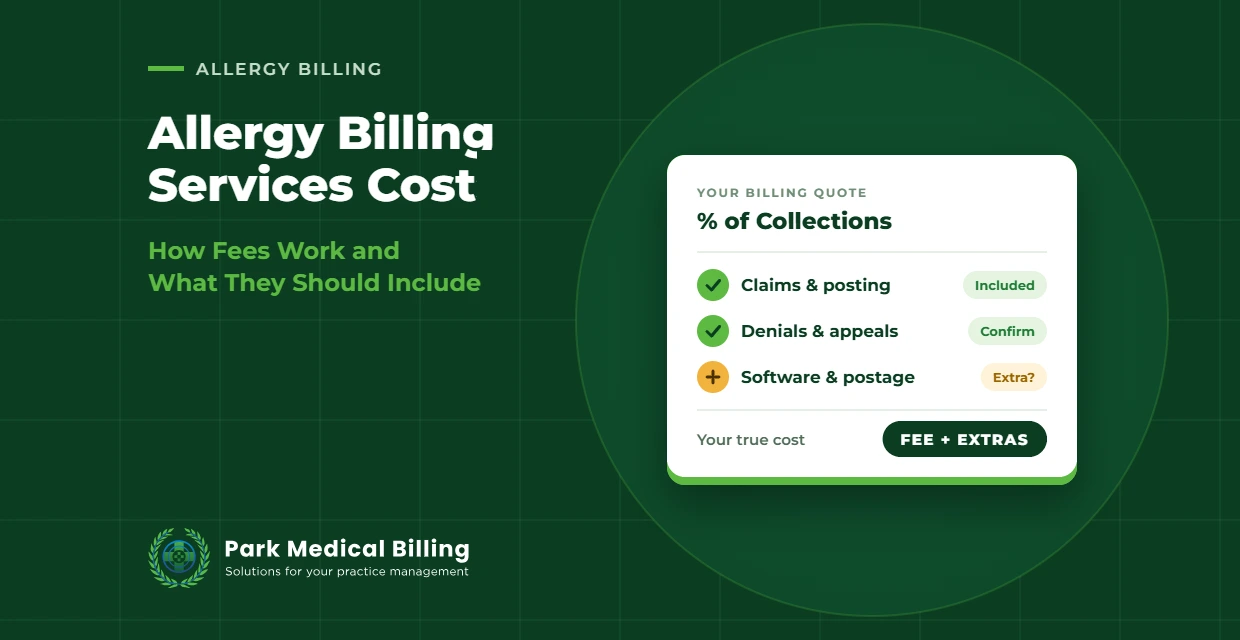
Allergy billing companies may use percentage-based, per-claim, or flat-fee pricing. Before comparing quotes, it’s important to understand what you’re paying for.
This guide explains how allergy billing fees are structured, what they should include, and how to compare quotes.
How Are Allergy Billing Services Priced?
A billing company sets its service fees through its agreement with the practice. The fee may be based on collections, billed charges, claims handled, or a fixed monthly amount, and the total depends on the defined scope of work.
Note: Before comparing quotes, check how the fee is calculated, what billing tasks are included, and whether additional charges apply.
Common Medical Billing Fee Structures
Medical billing companies generally offer different pricing structures depending on the services provided.
- Percentage of collections: The billing company charges an agreed percentage of the payments received by the practice, based on the collections defined in the contract.
- Percentage of billed charges: Fees are calculated from the charges submitted by the practice rather than the payments collected.
- Per-claim pricing: The practice pays an agreed fee for each claim processed or submitted, depending on the contract.
- Flat monthly fee: The practice pays a fixed amount for an agreed scope of billing services.
Some agreements may also include monthly minimum fees or separate charges for services outside the agreed scope.
Suppose a practice bills $100,000 and collects $55,000. At the same hypothetical 4% fee, billed charges produce a $4,000 service fee, while collections produce a $2,200 fee. The fee base alone changes the result by $1,800. Actual agreements may exclude certain collections or apply other terms.
The important question is not just how the fee is calculated, but what the practice receives in return.
What Affects the Cost of Allergy Billing Services?
Your Mix of Testing, Immunotherapy, and Office Visits
The types of services your allergy practice provides can affect the billing work involved. Allergy testing, immunotherapy injections, extract preparation, and office visits may have different coding, documentation, and payer requirements.
When comparing billing services, ask whether the proposed fee covers the review and follow-up needed for each type of claim.
Claim Volume, Provider Count, and Payer Mix
These show how many claims will be submitted, how many payer rules apply, and how much follow-up to expect. A practice with several providers and many payers generally requires more workflow than a single-provider practice with a few.
Existing Denials and Unpaid Claims
Ongoing billing and taking over an existing backlog are different jobs. Working older denials and unpaid claims may be priced differently from billing new services.
How Much Work the Practice Wants to Outsource
The quote changes with the agreed responsibilities, such as authorization support, coding review, patient billing, and appeals. A narrower scope usually means fewer tasks covered, so compare scope as carefully as price.
What Should the Allergy Billing Fee Include?
Treat each service below as an item to confirm in the written agreement, along with who is responsible for it.
Eligibility, Benefits, and Authorization Support
Confirm who handles eligibility and benefits verification, tracks authorization approvals and renewals, and communicates coverage-related issues. Ask when these checks are performed and which responsibilities remain with your practice.
Allergy Coding and Charge Review
Ask what the review covers, including testing units, extract preparation, injection administration, and supporting documentation. Specific coding rules should follow applicable payer guidance.
Claim Submission and Rejection Corrections
Ask whether the service includes confirming that claims were accepted and correcting rejected submissions.
Payment Posting and Underpayment Review
Clarify who posts payments, reconciles adjustments, and investigates payment discrepancies.
Denial Follow-Up and Appeals
Confirm whether the fee includes investigating denials, requesting records, submitting corrections or appeals, and tracking resolution.
Patient Billing and Performance Reporting
Ask about patient statements, billing inquiries, A/R aging, denial trends, and reports by payer or service type.
Responsibility checklist (use it to review any proposal):
| BILLING TASK | WHAT TO CONFIRM | BILLING COMPANY’S RESPONSIBILITY | PRACTICE TEAM’S RESPONSIBILITY |
|---|---|---|---|
| Eligibility and Benefits | Is timing and scope documented? | Checks eligibility and benefits within the agreed scope and flags identified issues | Provides accurate patient and insurance information |
| Authorization Support | Are requests, renewals, and follow-up included? | Tracks approvals and renewals | Reports treatment changes, supplies clinical details |
| Coding and Charge Review | Which codes and records receive review? | Reviews testing units, extracts, injections, documentation | Documents services clearly, answers coding queries |
| Claim Submission and Rejections | Are rejections corrected without an extra charge? | Submits claims, checks acceptance, corrects rejections | Provides charge details promptly |
| Payment Posting and Underpayments | Are discrepancies investigated? | Posts payments, reconciles adjustments, investigates discrepancies | Approves adjustments and write-offs under practice policy |
| Denial Follow-up and Appeals | Are appeals limited by count or age? | Investigates denials, requests records, submits appeals, tracks outcomes | Supplies records and clinical input |
| Patient Billing | Are statements and postage included? | Sends statements and answers billing inquiries, if agreed | Handles front-desk payments and care questions |
| Reporting | Which metrics and reporting frequency? | Provides A/R aging, denial trends, payer and service reports | Reviews reports and acts on findings |
Want a written fee breakdown for your practice? Request a free consultation or call (201) 585-7306.
Which Services May Cost Extra?
Some work may be priced outside the main fee. Services that may be charged separately include:
- Setup, data migration, or system connections.
- Software and clearinghouse access.
- Credentialing and payer enrollment.
- Recovery of older unpaid claims.
- Patient statements and postage.
- Work outside the agreed authorization or appeals scope.
- Contract termination assistance and data export.
Owners and billers should confirm these charges before signing.
How Does the Fee Apply to Biologic Drug Collections?
Biologics require special attention because the billing-fee base may include drug reimbursement as well as administration payments. Under buy-and-bill, the practice purchases a drug and bills for it when covered and payable. The payment is not all profit because the practice also paid to acquire the drug.
Under some specialty-pharmacy arrangements, the pharmacy supplies the drug and the practice bills for administration rather than for the drug itself. The exact workflow and reimbursement depend on the payer and arrangement.
Illustrative Biologic Drug Billing Example
CMS generally bases Medicare Part B drug payments on Average Sales Price (ASP) plus 6%. For example, a drug with a $1,000 ASP would have an illustrative payment of $1,060.
If the acquisition cost is $1,000, the difference is $60. A hypothetical 4% billing fee on $1,060 would cost $42.40, leaving just $17.60 before other expenses.
Actual payments and costs may vary. Source: CMS
Here are some important questions to ask:
- Does the percentage apply to drug reimbursement, administration reimbursement, or both?
- Are drug collections excluded or priced separately?
- Who handles authorization, payment reconciliation, and related follow-up?
- How does the agreement treat each acquisition arrangement the practice uses?
Ask any billing company whether its agreement covers authorization requests and follow-up for specialty drugs and injections. An authorization does not guarantee payment; applicable coverage, documentation, and claim requirements still matter.
What Will Your Practice’s Allergy Billers Still Handle?
Outsourcing divides the work, but it does not remove your team from it. Your staff typically still needs to:
- Provide accurate patient and insurance information.
- Supply clinical documentation and charge details.
- Communicate treatment or authorization changes.
- Answer the billing company’s queries.
- Approve adjustments or write-offs under practice policy.
- Review unresolved claims together with the billing team.
Agree on responsibilities, communication channels, and response times up front.
How Can You Compare Allergy Billing Quotes Fairly?
Give each company the same practice information and compare total fees at the same claim volume, service scope, and contract period. The examples below are hypothetical, not market price estimates or actual PMB quotes.
| ITEM TO COMPARE | QUOTE A (ILLUSTRATIVE) | QUOTE B (ILLUSTRATIVE) |
|---|---|---|
| Pricing Structure | Illustrative 4% of collections | Illustrative 3% of collections |
| Monthly Minimum | None assumed in example | None assumed in example |
| Included Billing Tasks | Claim submission, payment posting, denial follow-up, and reporting | Claim submission, payment posting, and reporting |
| Authorization Support | Included | Optional add-on ($800 in example) |
| Older A/R Follow-Up | Included | Optional add-on ($500 during the backlog period as in the example) |
| Denial Follow-Up | Included | Charged separately |
| Biologic Drug Collections | Excluded from the fee calculation | Included in the fee calculation |
| Software and Statements | Included | Additional charges |
| Reporting and Communication | Scheduled reports and dedicated contact | Self-service reports. |
| Contract and Exit Terms | Longer fixed term assumed | Shorter cancellation notice assumed |
Illustrative Monthly Calculation
Suppose a practice collects $100,000, excluding buy-and-bill drug collections.
Quote A charges a hypothetical 4% ($4,000), including authorization and older A/R follow-up. Quote B charges a hypothetical 3% ($3,000), plus $800 for authorization and $500 for older A/R work during the backlog period, bringing its subtotal to $4,300.
This excludes Quote B’s separate denial follow-up, software, and statement charges, which would increase its total if applicable. Including biologic drug collections in Quote B’s fee base could increase it further.
After the backlog period, Quote B drops to $3,800, and without either add-on it would cost $3,000, making it the cheaper option for a practice that doesn’t need them. Neither quote wins automatically: compare the total cost for the work your practice actually needs.
These figures are hypothetical, not actual market rates or PMB pricing.
Also compare the promised reporting and actual performance measures, such as denial rate, days in A/R, and collection rate. Define how each metric will be calculated and reported. A lower fee is not useful if important follow-up falls outside the agreement.